
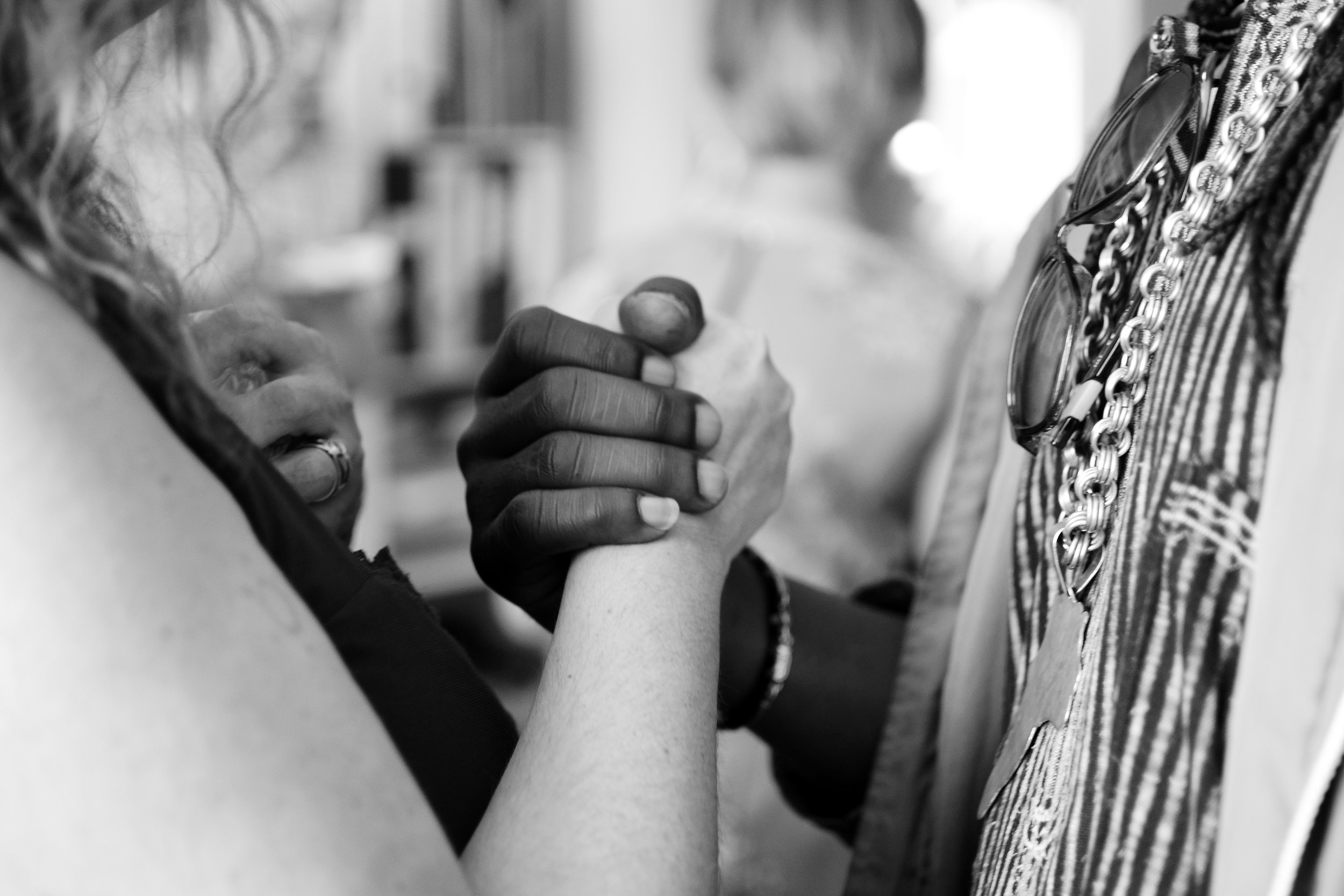
Why I'm talking about Biases
Ann Ajet has written a great blog which should be both a challenge and and encouragement to all of us, as we respond to recent events across the world.
15 weeks ago, Ahmaud Arbery went out for a jog and never came home. Two white males saw Arbery running in their neighbourhood in Brunswick, Georgia and decided he was “dangerous” and took it upon their own volition to chase him and shoot him to death. Sadly, this simple narrative of black guilt has played out devastatingly in a pattern of unjustified killings in the US. In the Arbery case, I asked myself - what sort of world must these two white males inhabit to draw to the conclusion that a black man jogging must mean he is guilty of something?
Perhaps these two males existed in a very white world, perhaps they didn’t have any black friends, perhaps they viewed black people as threatening? A survey in the US found that 75 percent of white Americans have “entirely white social networks”[1]. Based on this data, it can be easy to see how these types of homogenous settings can set up the conditions where the archetype of the black person being “dangerous and threatening” is perpetuated.
I saw this played out in my own life. When I first introduced my black boyfriend (now my husband) to my parents, they had shared their concerns with him about the safety of their daughter. They feared he would be like many of the “black people” they saw on the news who committed crime. I don’t doubt my parent’s concern for me but their fear was unfounded and ill-informed.
LOVE THE INDIVIDUAL IN FRONT OF YOU
When we deflect the opportunity to know a person as an individual, we default to stereotypes. We do this by creating caricatures we’ve erroneously extrapolated from a racial subset. We contradict ourselves when we wouldn’t bind the same extrapolations to our own racial group - because we know enough people of our ethnicity to know that it consists of rich and varied characters. Existing in our own social bubbles gives currency to these stereotypes and until we resist the cultural tide and spend quality time with other people from outside our own groups; we won’t see them as an individual - as a fully formed human being with hopes, desires and fears just like us.
In a moment of unwarranted fear, these two white males shot Ahmaud Arbery. This tragic case displays how insidious thoughts and mindsets can lead to actions. Unchecked and not dealt with, can lead to devastating consequences.
As a Christian, what drew me to the character of Jesus Christ was how he accurately diagnosed our condition. He took a scalpel to our inner lives and exposed the root of our sin. “For it is from within, our of a person’s heart, that evil thoughts come. All of these evils come from inside and defile a person”. (Mark 7:21-23). Ill thoughts are first harboured in the heart and mind and until we deal with that, sin becomes malignant and spreads to something more troubling.
I respect the actions of many who bring attention to the injustices coming from the US - protests and petitions have been set up to find justice for Ahmaud Arbery, George Floyd and other black lives that have been killed carelessly. However, long lasting changes have to run deeper - we need to understand the conditions that set up racism. - As Martin Luther King puts it:
“We are called to play the good Samaritan on life’s roadside; but that will be only an initial act. One day the whole Jericho road must be transformed so that men and women will not be beaten and robbed as they make their journey through life. True compassion is more than flinging a coin to a beggar; it understands that an edifice that produces beggars needs restructuring”
What King refers to is more than exonerating our guilt with a coin but collectively having deep paradigm shifts that can change the game.
DIVERSITY AND INCLUSION IN THE CHURCH
I value being part of a diverse church, I also value the fact that my gym is also diverse. It’s sad yet true - that it’s possible to sit with one another at church yet keep one another at a distance. The real litmus test of authentic diversity is who are we allowing in our lives, who do we have meaningful relationships with, who do we confide in, who do we allow to influence us? This is much harder to cultivate, it’s the difference between diversity and inclusion, Verna Myers, a diversity strategist puts it “Diversity is being invited to the dance, Inclusion is being asked to dance”.
I am blessed to be part of a church where my leaders foster an environment where multiple races are represented at the front and in the middle. As a result, I have brothers and sisters from many backgrounds - I truly embrace that and thank God for these rich experiences. Still, I see many homogenised groups existing in our churches. This is problematic particularly in London when there’s no legitimate reasons why that would be so.
Statistics suggests that one third of white Britons have no friends outside their own ethnicities [2]. Other factors play a role here but data suggests non-white people are more open to friendships outside their own race than Caucasian people are. It would be interesting to ask the question, how do these separations evolve?
I celebrate the fact that as a society, there have been huge leaps forward in stamping out overt forms of racism, but as Christians, our convictions and model of love has to be calibrated to the Bible. In order to move the dialogue meaningfully - I think we need to talk less in terms of racism, a term that often invokes images of white supremist or racist chanting football fans. A term which we can shirk the label of and tune out hearers. We need to change the script and talk in categories of bias and prejudices which are more prevalent, which as a compromised human being - I feel my own biases.
WHAT CAN WE DO?
It’s important to bring into the light, something that operates in its inherent invisibility. Our non-verbal cues to people different from us are just as revealing as our verbal cues, they can signal to someone - I do/don’t want to know you better, I value you (less). This is not about perfection but these things are simply invisible to some of us or that we’ve persisted in these attitudes unchallenged for so long that they’ve become our automatic responses.
It’s a call for self-examination and an awareness of our unconscious biases. By bringing these things into the light – we give them less authority over us and we can make intentional movements towards the way of love. Redressing our biases, developing positive associations with other ethnicities and reshaping our heart and outlook.
We do ask our leaders to break it down for us, speak incisively into our contexts and to cultivate a culture where discipling relationships are the norm. This needs to be more than a reactive mandate to stamp out racism but a proactive command to love one another. As our aperture widens with the re-education of black history - our hearts are more visible to the fact that implicit in Jesus’s cornerstone command to love one another is a call to love everyone - Jews and Gentiles, Black, Brown and White, “and by this all men will know you are my disciples, if you love one another”. John 13:35.
On this side of heaven - I’m realistic that we will never reach perfect love and unity. “When the Perfect comes, the partial shall pass away” (1 Corinthian 13:10). Our identity in Christ is above our ethnic identity, the father declares our ultimate worth and dignity. However, we can’t avoid the chasm, we need to see it and close it as much as possible. It’s a return to discipleship, of being aware of our earthly nature, growing in confession and turning to the redemptive power of Christ and doing our best to walk as Jesus walked.
By Ann Ajet
Footnotes
[1] https://www.prri.org/research/poll-race-religion-politics-americans-social-networks/
[2] https://yougov.co.uk/topics/politics/articles-reports/2018/05/03/one-third-white-britons-dont-have-any-friends-ethn

How Hope Carries Us Through This Pandemic
It’s been 8 weeks since we’ve been in lockdown in London and there are now talks of a lockdown being eased. As this happens, and off the back of this Sunday’s message at Redeemer, Ann Ajet talks to us about hope.
It’s been 8 weeks since we’ve been in lockdown in London and there are now talks of a lockdown being eased. My prevailing feelings of boredom, memories of the unfettered ways I could be enjoying my day is bubbling to a strong, heightened sense of longing. I most look forward to alfresco dining amidst the emerging summer breeze in the warm company of family & friends.
This is my Hope, a return to all the things I once found simple pleasure in.
It seems that hope has a purpose, it reframes our present. Hope is a feeling of expectation that something good will happen. Because the current pandemic causes us to press pause on the present, it focuses our attention on the future. It’s our envisioned future that helps us get through the now and suggests there’s something about our present that we are discontent with while we wait for what we want.
God created us as embodied social human beings who thrive off the energy of others, isolation has severely curtailed that for me. I miss the urban life and the kinetic buzz garnered from being in a room packed full of people. I miss the spontaneous vis-à-vis conversations, banter about everything from the frivolous to the deep. Yes, these still take place on zoom but it’s simply not the same as being in the same room as someone else. The fact is, we are humans that never stop longing for something, lockdown or no lockdown - our ever-evolving desires will never fade away. The pandemic has served to draw us back towards our basic human instinct - to survive and avoid catching CO-VID 19.
Perhaps the collective feeling that we are all in this together, is for many, a welcomed respite from FOMO - when we are all sanctioned to our homes there is less to miss out on. Or perhaps we welcome the withdrawal from the individualistic daily hustle to be someone and “make our mark in the world”. Confined to our homes, stripped of the superfluous and focussed on the essential, there’s no need to distinguish ourselves, to draw attention and compare.
Our basic need becomes food, water and shelter - the first few weeks has shown how quickly our human instinct kicks in when an unannounced deadly virus arrives on the scene. But as we are now experiencing, when the viral pandemic becomes more controlled and risks minimised - we start to turn our attention elsewhere. According to “Maslow Hierarchy of Needs”, secured of our basic needs - our new baseline for survival becomes the next rung; we look to get back on the dating scene; to find the partner of our dreams; we seek out our next career manoeuvre; we aim for 200 more followers on Instagram.
Our moving goal post shows we are hope-based humans.
We are continually moving along a spectrum of desires - an excellent education, a flourishing career, the perfect spouse, a granite kitchen top in our Pinterest home, well-behaved children. As the cyclical pattern begins again - we want the same for our children. We have endless desires that realistically won’t be fully met in our lifetime. None of these things are wrong, we were created with an impetus to build families, homes and careers. This pandemic is frustrating because it has become a glaring obstacle, an invasion of our plans.
We are fundamentally creatures with intrinsic desires that propel us to the next thing. Most of us are already daydreaming about what post-lockdown life will look like. But the landscape will not look the same for everyone. Economically, businesses unable to remain financially viable will perish and jobs will go. Until we find a vaccine, people will face severe health challenges and we will lose loved ones. Lockdown may have perhaps spurred you to re-evaluate your direction and question whether you’re building the right career or are in the right relationship.
Sooner or later, we face a time when our dreams don’t feel like they are coming to fruition, we face disappointment from our relationships, work and health. Disappointments are a direct confrontation of our broken world as we try to reconcile our ever-increasing hopes and desire versus the limitation of an imperfect word. This doesn’t mean we should give up, our desires reveal to us a greater vision of the good life, as CS Lewis summarise so well:
“Creatures are not born with desires unless satisfaction for those desires exists. A baby feels hunger: well there is such a thing as food. A duckling wants to swim: we, there is such a thing as water. Men feel sexual desire: well, there is such a thing as sex. If I find in myself a desire which no experience in this world can satisfy, the most probable explanation is that I was made for another world.” [1]
We sense something other-worldly because we were wired by our maker to want to live forever. He has placed “eternity in the hearts of men so that we will seek him” (Ecclesiastes 3:11). On a conscious or subconscious level, we desire to be eternal – to make our mark in the world after we’re gone by chasing after things through recognition. Think about it, every endeavour we chase is a pursuit to be remembered forever, we try to do this by living on through our family or through our work. We’re summoned to do this because we think there is one life, as the current truism goes; we are implored to “to live our best life” now.
As the past few weeks have shown us, death doesn’t discriminate – rich or poor, famous or not – we are all subject to death. When the late Apple founder Steve Jobs faced mortality, he was able to distil this gnawing feeling we have to “be eternal”:
“It’s strange to think that you accumulate all this experience, and maybe a little wisdom, and it just goes away. So I really want to believe that something survives, that maybe your consciousness endures.” [2]
Jobs understood something about the coldness of death. Former first lady, Michelle Obama describes the sudden death of a close friend in a similar way, she says how death was “perverse, how the world just carried on”[3]. I believe Michelle Obama is spot on: death is perverse and unnatural, deep down we want to believe that we’re not some stat on a bell curve; that death is not an on-off switch and we’re gone.
Death is unnatural because God created us for something more. God has placed eternity in our hearts because an eternity exists. Jesus says “I am the resurrection and the life. The one who believes in me will live, even though they die” (John 11:25).
Our Hope is not wishful thinking but a confident assurance in the only person in history to have raised himself from the dead, the only one that holds the keys to death and can give us true eternity.
By Ann Ajet
Ann is a major foodie and likes to explore street food markets with her husband and daughter. She also likes writing about deep stuff at Bread.
[1] Mere Christianity by CS Lewis
[2] Steve Jobs by Walter Isaacson
[3] Becoming by Michelle Obama

#RedeemerRecommends - Bread
#RedeemerRecommends a blog curated by a member of the Redeemer Family!
Here at Redeemer we love to celebrate the gifting of members of our family! This week on #RedeemerRecommends we are pointing you in the direction of another blog contributed to and curated by Ann Ajet, who attends Redeemer with her family!
Bread is described as being ‘for today’s emerging generation of thoughtful disciples.’ We hope that you will be challenged and informed by their articles! We are also hoping to publish some articles written by Ann on the Redeemer blog in the near future, so keep your eyes peeled!